
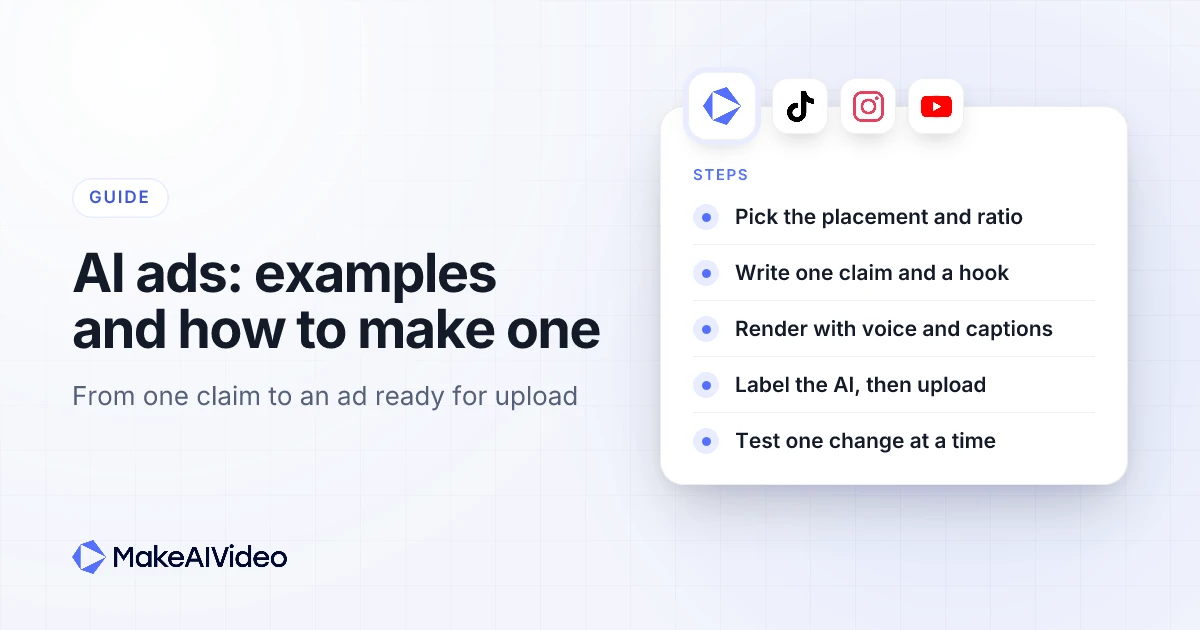
AI ads are adverts where some or all of the creative is made by AI: the script, the voiceover, the scenes, the presenter, or the whole film. To make one, pick where the ad will run, write one claim with a hook in the first seconds, generate the video in that placement's aspect ratio, check it with the sound off, label the AI where the platform asks, and test one change at a time. Big brands now run AI commercials on TV, and small brands run AI video ads on Reels and TikTok every day.
This guide covers both. First the formats AI ads come in, then three real AI ad examples from Coca-Cola, Kalshi and McDonald's and what each one teaches, then a step-by-step workflow in MakeAIVideo's AI ad maker with real credit costs, the labelling rules, and the mistakes that sink AI generated ads. One note on the term: "AI ads" also gets used for ads shown inside AI chatbots. This post is about the other meaning, ads made with AI.
Written by Jamie Partridge, Founder of MakeAIVideo.
What are AI ads?
An AI ad is any advert where generative AI does a production job a person or a crew used to do. That ranges from a narrated product ad built from your photos in a few minutes, to a 60 second TV commercial where every shot was generated. The AI part changes the cost and the speed. It does not change what makes an ad work: a clear claim, an opening that earns the next second, and a reason to act.
Most AI video ads fall into five formats. Pick the format before you pick a tool, because each one suits a different job.
| Format | What AI makes | Best for | Where to make it |
|---|---|---|---|
| Narrated product ad | Script, voiceover, matched footage, captions, with your product photos in the product scenes | Shop and DTC ads on Reels, TikTok, Facebook feed | The product ad tool |
| UGC-style creator ad | An AI presenter talking to camera, lip-synced to your script | Direct-response tests, app installs | Creator-style ads |
| Spokesperson ad | A consistent brand presenter reading approved words | Launches, B2B, landing pages | Presenter videos |
| Product motion clip | 5 or 10 seconds of movement from one photo | Short feed ads, Stories, retargeting | Photo animation |
| Fully generated commercial | Every scene, character and setting | Brand films, TV, seasonal campaigns | Prompt to video |
The first four are what most small teams run week to week. The last is what makes the news, so that is where the examples start.
Real AI ad examples from big brands
These three AI commercials are worth studying because each one taught the industry something different. One shows what testing can tell you, one shows how cheap and fast a broadcast ad can be, and one shows that AI does not rescue a weak idea.
Coca-Cola: "Holidays Are Coming" remade with AI
Coca-Cola's holiday truck ad first aired in 1995. In 2024 the brand released an AI-generated remake. TheWrap reported that the ad agency Pereira O'Dell and Silverside AI produced it, keeping the convoy of red trucks while the children, who had been filmed live in earlier versions, were AI-generated.
Coca-Cola came back with AI again in 2025. Its own announcement describes two AI-driven reimaginings of the 1995 spot made with Secret Level and Silverside AI, a 60 second cut and a 90 second "Fantastical" cut, with music performed and sung by real artists. Coca-Cola's Pratik Thakar said: "Creative ambition, direction and thought leadership has and always will be human-led." Food Dive reported that the new version was facing backlash, while Coca-Cola's global VP for creative strategy and content said of its AI holiday ad: "this is one of our top-tested ads in history, period."
What it teaches: online reaction and test results can point in opposite directions. The brand kept going and pointed to its own testing. If you run AI ads, decide in advance which numbers you will judge them by, and judge them by those, not by the comments.
Kalshi: an AI commercial during the NBA Finals
In June 2025, the prediction market Kalshi ran a 30 second spot during the YouTube TV stream of Game 3 of the NBA Finals in which every clip was AI-generated. NPR reported that the creator, P.J. Accetturo, made it in two days, and that a Kalshi spokesperson put "the actual cost of prompting the AI" at "under $2,000", not counting Accetturo's fee. Accetturo said it "took about 300–400 generations to get 15 usable clips."
What it teaches: the cost of a broadcast-quality look has collapsed, but the work has not disappeared. It moved into writing, generating many takes and choosing the few that work. The ad also leaned into absurd, deliberately strange characters, a style where AI's odd edges read as a choice rather than a flaw.
McDonald's Netherlands: an AI Christmas ad pulled within days
In December 2025, McDonald's Netherlands released a 45 second AI-generated Christmas ad made by The Sweetshop Films and the agency TBWA/Neboko. NBC News reported that it showed a run of Christmas mishaps, from presents falling off a car to a man left hanging upside down after putting up Christmas lights, and ended by urging viewers to "hide out in McDonald's till January's here." The company removed it after the reaction on social media, saying it "was intended to reflect the stressful moments that can occur during the holidays in the Netherlands." One critic called it "so cynical and unfun," even setting the AI aside.
What it teaches: a lot of the anger was about the idea, not the pixels. A cynical message in a season people feel warmly about would have struggled however it was made. AI makes it cheaper to produce an ad, which also makes it cheaper to ship a bad brief. Test the idea before you test the render.
AI video ad examples you can copy this week
Brand films get the headlines, but most AI ads that pay their way are 15 to 30 second social ads. Here are four briefs for the formats above. Each one is the kind of description you would give a tool in a sentence or two. Swap the brackets for your product.
A DTC product ad (narrated, 9:16, Reels or TikTok):
"[PRODUCT] is a [WHAT IT IS] for [WHO IT IS FOR] who [PROBLEM]. The main claim: [ONE SPECIFIC BENEFIT]. Open on the problem, not the brand. Call to action: Shop now."
A UGC-style app ad (AI presenter, 9:16):
Hook: "I stopped [ANNOYING TASK] the day I found this app."
Body: One sentence on what the app does, one on the result, in a casual first-person voice.
Close: "It's free to try. Link below."
A local restaurant ad (product motion clip, 9:16, 10 seconds):
"Slow push in on the plate, steam rising, warm light, nothing else moves."
A B2B launch ad (spokesperson, 16:9 or 1:1):
Hook: "Your team spends [TIME] a week on [TASK]. That just ended."
Body: What shipped, who it is for, the one number that matters.
Close: "Book a demo."
The prompts are short on purpose. A good AI ad brief names one audience, one claim and one call to action. Anything more turns into a second ad competing with the first. For a longer script, the hook-body-close structure in our script guide maps straight onto a 30 second ad, and the hook ideas tool drafts openers you can paste into a brief.
Turn a product photo into a ready-to-upload ad. Describe what you sell, add 1 to 5 product photos, pick the placement and the call to action, and MakeAIVideo writes, voices and captions the ad. Try it on your own product
How to make AI ads, step by step
This is the workflow for a narrated product ad, the most common kind of AI video ad for a small brand. The same steps apply to the other formats with a different starting tool.
1. Pick the placement first
Where the ad runs decides its shape and length, so choose it before you write anything. In the Ad Maker the placement sets both: TikTok in-feed comes out 9:16 at 20 seconds, Reels and Shorts 9:16 at 30 seconds, the Facebook feed 1:1 and YouTube in-stream 16:9, both at 30 seconds. Each render is one aspect ratio. If the same ad needs to run in another shape, switch the ratio in the editor and export again rather than cropping a finished file, because cropping clips the framing and the captions.
2. Write down one audience and one claim
Before you generate, write one line: who the ad is for and the single thing it promises. "Runners who hate blisters: these socks stay dry for a full marathon" is an ad. "Comfortable, stylish, sustainable socks for everyone" is three weak ads in one. If you have a second claim, it gets its own ad.
3. Put the hook in the first three seconds
Every platform says the same thing about the opening. HubSpot's look at in-stream ads notes you have "anywhere from one to five seconds to grab your viewer's attention" before they skip. Buffer cites TikTok's own research that "over 63% of all videos with the highest click-through rate (CTR) highlight their key message or product within the first three seconds." And Google's ABCDs of effective video ads tell advertisers to "introduce your brand or product from the start and maintain that presence."
So open on the problem, the claim or the price. Not a logo card, not "Hey guys". If you are stuck, draft five openers and pick the one you would stop scrolling for.
4. Generate the ad
In the Ad Maker, describe what you sell in a sentence or two, add 1 to 5 real product photos, pick the placement, then pick a call to action such as Shop now, Book a demo or Learn more, or write your own. It writes the hook, body and close, records the AI voiceover, matches real filmed footage to each line and times captions to the voice. Product scenes show your photos exactly as you uploaded them, so the ad never invents a version of your product. Prefer your own words? Paste the script into script to video and the narrator reads it as written.
For a presenter instead of footage, use the UGC creator format: pick an AI character, paste the script, and it renders a lip-synced 9:16 creative with captions. Our AI UGC ads playbook covers briefs, formats and metrics for that style in depth.
5. Watch it once with the sound off
Feed ads are often watched muted. Play the render silent and ask whether the captions alone carry the claim and the call to action. Then watch it with sound and check the voice matches the buyer: a calm read for skincare, a punchier one for fitness. If one scene is wrong, regenerate that scene, swap the narrator or restyle the captions in the editor rather than starting again.
6. Add the extras in a regular editor
Some things belong in an editing app after the render: an end card with your logo, a discount-code bar, an expiry date or a delivery partner's logo. MakeAIVideo does not add an end card for you. Keep these overlays simple, and pull the ad the day an offer expires.
7. Export, upload and label
Download the 1080p MP4, which carries no watermark on any plan, and upload it to Meta Ads Manager, TikTok Ads Manager or Google Ads as a new creative. Tick the AI disclosure where the platform asks for it (more on that below).
8. Test one change at a time
Each run makes one ad. There are no automatic variants, and that is a feature for testing: change the hook line, run again, and keep the body and offer the same so the result tells you something. Let the auction pick the winner, then test the next variable, such as the voice or the call to action.
One claim, one hook, one run. Make the first ad in minutes, then change only the opening line and run it again to see which hook wins. Plans start at $9 a month. Start your 7-day free trial
How much does it cost to make an AI ad?
The cost of AI ads ranges from a handful of credits to a full agency budget. Kalshi's spot shows the low end for broadcast, and Coca-Cola's shows that big brands still put real teams behind AI commercials. For a social ad made in MakeAIVideo, the cost is in credits and depends on the format and length. These are typical totals, all in: script, voice, scenes, captions and export.
| AI ad format | Length | About |
|---|---|---|
| Narrated product ad over real footage | 30 seconds | 112 credits |
| UGC-style ad with an AI presenter | 15 seconds | 246 credits |
| UGC-style ad with an AI presenter | 30 seconds | 439 credits |
| Talking presenter ad | 30 seconds | 584 credits |
| Product motion clip from one photo | 5 seconds | 92 credits |
| Product motion clip from one photo | 10 seconds | 163 credits |
| Fully AI-generated scenes with voice | 30 seconds | 612 credits |
| Re-export in another aspect ratio | 30 seconds | 19 credits |
Plans include monthly credits: Lite $9 (600), Solo $19 (1,100), Plus $29 (1,750) and Pro $49 (3,000). The app shows the exact credit cost before you hit Generate, so you can trim the script or switch format first. See plans and credit costs for the full breakdown.
The cheapest way to test is the narrated product ad. Real footage costs far less than fully generated scenes, which makes hook tests affordable. Save fully generated scenes for when the idea has proved itself. Before you spend on media, the CTR calculator and ROAS calculator help you set the bar each ad has to clear.
Do AI ads need to be labelled?
Often, yes, and the rules differ by platform and by type of ad. Check the current policy each time you launch, because these pages change.
- TikTok: TikTok's ad disclaimer guide lists "AI-generated, synthetic, or manipulated media" as a mandatory disclaimer, including "images, video, or audio that are completely AI-generated" and real footage significantly changed by AI.
- Meta: Meta's policy for social issue, election and political ads says advertisers must disclose when such an ad contains a photorealistic image or video created or edited with generative AI, for example to "depict a realistic-looking person that does not exist." Ordinary product ads fall outside that rule.
- The FTC (US): the FTC's final rule on fake reviews and testimonials covers testimonials that misrepresent that they are by someone who does not exist, "such as AI-generated fake reviews."
That last point matters most for UGC-style AI ads. An AI presenter can speak as your brand: "Here's what our socks do." It must not pose as a real customer describing an experience that never happened. Keep the presenter as a presenter, and the ad stays honest.
Why do some AI ads fail?
The failed AI ads in the news and the failed ones in small ad accounts tend to share the same causes.
- A weak idea, rendered well. The McDonald's ad shows that viewers judge the message first. Fix the brief before the pixels.
- Uncanny people up close. Realistic faces that are slightly off draw attention to the method. For people, a consistent presenter reading a clear script works better than a crowd of generated extras.
- Two claims in one ad. It dilutes the hook. Split it into two ads and test them.
- A logo intro. The first three seconds are the most expensive in the ad. Spend them on the hook.
- The wrong shape. A 16:9 ad cropped to 9:16 loses its captions and framing. Render each placement in its own ratio.
- Fake customers. An AI "customer" with an invented story risks both the platform's rules and the FTC's. Use a presenter, or real reviews with permission.
- No test plan. Generating is fast, so it is tempting to ship ten unrelated ads. Change one thing at a time or the results tell you nothing.
Make the ad, keep the claim honest. MakeAIVideo's presenters are AI-generated from the start, so there is no real person's likeness to license, and product scenes show your real photos. See how ad generation works
AI ads for small businesses vs AI commercials for brands
The examples above are national campaigns with agencies and testing budgets. A shop, an app or a local service runs a different game: lots of small, cheap tests on paid social rather than one big film. That changes what to optimise.
For a big brand, AI is a way to make a film faster and for less, and the risk is reputational. For a small business, AI is a way to test far more hooks than a shoot day would allow, and the risk is spending on ads that were never tested properly. Start with a narrated product ad or a talking presenter, prove a hook, then scale the winner. Save a fully generated film for the moment a proven idea deserves a bigger canvas. If you sell on a store, our roundup for Shopify sellers covers the wider toolkit.
Frequently asked questions
What is an AI ad?
An AI ad is an advert where generative AI produces some or all of the creative, such as the script, voiceover, scenes or presenter. It can be a short social video or a full TV commercial.
Can AI make a commercial?
Yes. Brands including Coca-Cola and Kalshi have aired AI-generated commercials, with people still writing, choosing takes and editing. For social ads, a tool can turn a product description and photos into a narrated video ad in minutes.
How do I make an AI video ad?
Pick the placement, write one claim and a hook for the first three seconds, then generate the ad in that placement's aspect ratio. Check it muted, add any end card in an editor, label the AI where required and upload it to your ad manager.
How much does an AI ad cost to make?
In MakeAIVideo a 30 second narrated product ad costs about 112 credits, and a 15 second UGC-style ad with an AI presenter about 246 credits. Plans start at $9 a month for 600 credits.
Do I have to disclose that an ad was made with AI?
Often. TikTok requires a disclaimer on AI-generated ad media, and Meta requires one on political and social issue ads with photorealistic AI content. Check each platform's current policy before launch.
Are AI generated ads effective?
They can be, judged by the same numbers as any ad: hook rate, click-through and return on spend. Coca-Cola says its AI holiday ad tested among its best, while McDonald's pulled one after a poor reaction, so the idea matters more than the method.
Can I make several versions of an AI ad at once?
No, each run makes one ad in one aspect ratio. To test, change the hook line and run again, and export another ratio from the editor for each extra placement.

Written by Jamie Partridge
Founder at MakeAIVideo. Writing about AI video generation, scripting, scenes, and shipping content faster.